What is MACD?
MACD (Moving Average Convergence Divergence) is a momentum indicator that helps traders identify trend changes and potential entry/exit points. Think of it like an accelerometer in a car: just as an accelerometer measures how quickly your car is speeding up or slowing down, MACD measures how quickly a stock's momentum is changing.
When you're driving and the accelerometer shows you're accelerating, you know you're gaining speed. Similarly, when MACD shows bullish momentum, it indicates the stock price is likely to continue rising. When the accelerometer shows deceleration, you're slowing down—just like MACD showing bearish momentum suggests the stock price may decline.
MACD consists of three components:
MACD Line
The difference between a 12-day exponential moving average (EMA) and a 26-day EMA. This line oscillates around zero.
Signal Line
A 9-day EMA of the MACD line. This acts as a trigger for buy and sell signals.
Histogram (Optional)
The difference between the MACD line and Signal line, visualized as bars to show momentum strength.
How MACD Signals Work
Our platform uses the standard MACD parameters (12, 26, 9) to generate trading signals:
- Fast EMA: 12-day exponential moving average of closing prices
- Slow EMA: 26-day exponential moving average of closing prices
- MACD Line: Fast EMA minus Slow EMA
- Signal Line: 9-day EMA of the MACD line
- Signals are generated when the MACD line crosses above or below the Signal line
Buy Signals
A BUY signal is generated when the MACD line crosses above the Signal line:
- The MACD line was below or equal to the Signal line on the previous day
- The MACD line moves above the Signal line on the current day
- This indicates bullish momentum and potential upward price movement
What it means: The faster-moving average (MACD) is rising faster than the slower average (Signal), suggesting increasing buying pressure and potential price appreciation.
Sell Signals
A SELL signal is generated when the MACD line crosses below the Signal line:
- The MACD line was above or equal to the Signal line on the previous day
- The MACD line moves below the Signal line on the current day
- This indicates bearish momentum and potential downward price movement
What it means: The faster-moving average (MACD) is falling faster than the slower average (Signal), suggesting increasing selling pressure and potential price decline.
MACD Divergence — The Most Powerful Signal
While crossovers are the most commonly taught MACD signal, divergence is arguably the most powerful — and the most overlooked. Divergence occurs when price action and the MACD indicator move in opposite directions, suggesting the current trend is losing momentum before the price itself confirms it.
Bullish Divergence
Bullish divergence occurs when the price makes a new lower low but the MACD makes a higher low. This means selling pressure is weakening even as price falls — often a leading signal that a reversal is approaching.
Real example: In Q4 2022, Meta (META) fell from $175 to $90 between September and November. While the November price low was lower than the October low, the MACD histogram made a visibly higher low over the same period. This divergence preceded a dramatic reversal — META gained over 70% in the following three months as the divergence resolved to the upside.
Bearish Divergence
Bearish divergence is the mirror image: price makes a new higher high, but MACD makes a lower high. Buying pressure is weakening even as price climbs — a warning that the uptrend may be running out of fuel.
Real example: In late 2021, NVIDIA reached all-time highs near $330 (pre-split adjusted). But while price was surging, MACD momentum was declining with each successive peak — a classic bearish divergence. This divergence preceded a collapse from $330 to under $110 through 2022, a drop of over 66%.
Hidden Divergence (Trend Continuation)
Hidden divergence is a trend continuation signal rather than a reversal signal. Bullish hidden divergence occurs when price makes a higher low during a pullback but MACD makes a lower low — confirming the uptrend is intact and the dip is a buying opportunity. Bearish hidden divergence confirms the downtrend will continue. Advanced traders use hidden divergence to add to positions during pullbacks within a strong trend.
Reading the MACD Histogram in Detail
The histogram is the most underused component of MACD. It visualizes the gap between the MACD line and the signal line at each bar — giving you a real-time gauge of momentum intensity, not just direction.
- Bars above zero: the MACD line is above the signal line — bullish momentum is dominant
- Bars below zero: the MACD line is below the signal line — bearish momentum is dominant
- Growing bars: momentum is accelerating in the current direction
- Shrinking bars: momentum is decelerating — watch for a potential crossover
- The transition from negative to positive bars (or vice versa) marks the crossover signal itself
The most actionable histogram signal is the momentum fade: when histogram bars have been negative for several periods but are getting progressively smaller, it suggests selling pressure is drying up before the price actually reverses. This gives attentive traders an early entry opportunity ahead of the official crossover confirmation.
AAPL example (late 2022 into early 2023): After the 2022 selloff, AAPL's MACD histogram ran consistently negative for months. But starting in December 2022, the negative bars began shrinking week by week — from around -1.8 to -1.2 to -0.5 — while price was still declining or flat. The subsequent crossover in January 2023 confirmed the reversal. Traders who caught the shrinking histogram had a multi-day head start on the position.
Real-World MACD Examples: NVDA and AAPL
NVDA in 2023: A Textbook Bullish Crossover
NVIDIA entered 2023 trading around $140 — battered after a brutal 2022 that saw it fall from over $300 to under $110. In early January 2023, the MACD line crossed above the signal line: the 12-day EMA was recovering faster than the 26-day EMA, a sign that short-term buying pressure was outpacing the longer-term average. Momentum was shifting.
By May 2023 — just five months later — NVDA had surpassed $480. The MACD signal didn't predict the AI boom, but it confirmed that accumulation was happening before the mainstream narrative caught on. Traders using the bullish MACD crossover as an entry signal in January had a position at a fraction of the eventual high.
AAPL in 2022: When MACD Confirmed the Bear
Apple started 2022 near its all-time high of $182. By mid-January, the MACD line crossed below the signal line — the first bearish crossover of the year. Rather than reverse quickly, AAPL fell steadily for the next 10 months, hitting a low near $125 in December 2022 — a 31% decline from peak.
The January sell signal didn't predict the exact bottom, but it confirmed that upside momentum was exhausted. Traders who reduced exposure on the bearish crossover avoided most of the drawdown. Those who waited for RSI oversold readings alone got caught by brief bounces that failed to hold.
This illustrates a critical nuance: MACD crossovers are most reliable when they align with the broader market trend. In 2022, the S&P 500 was in a confirmed downtrend — bearish MACD signals on individual stocks were particularly reliable, while bullish signals on oversold bounces frequently failed.
Using MACD Signals on BriMindInvest
Our platform automatically calculates MACD signals for any stock you analyze:
- Navigate to the Stocks page and select a symbol
- Choose 'MACD Crossover' from the Signal Type dropdown
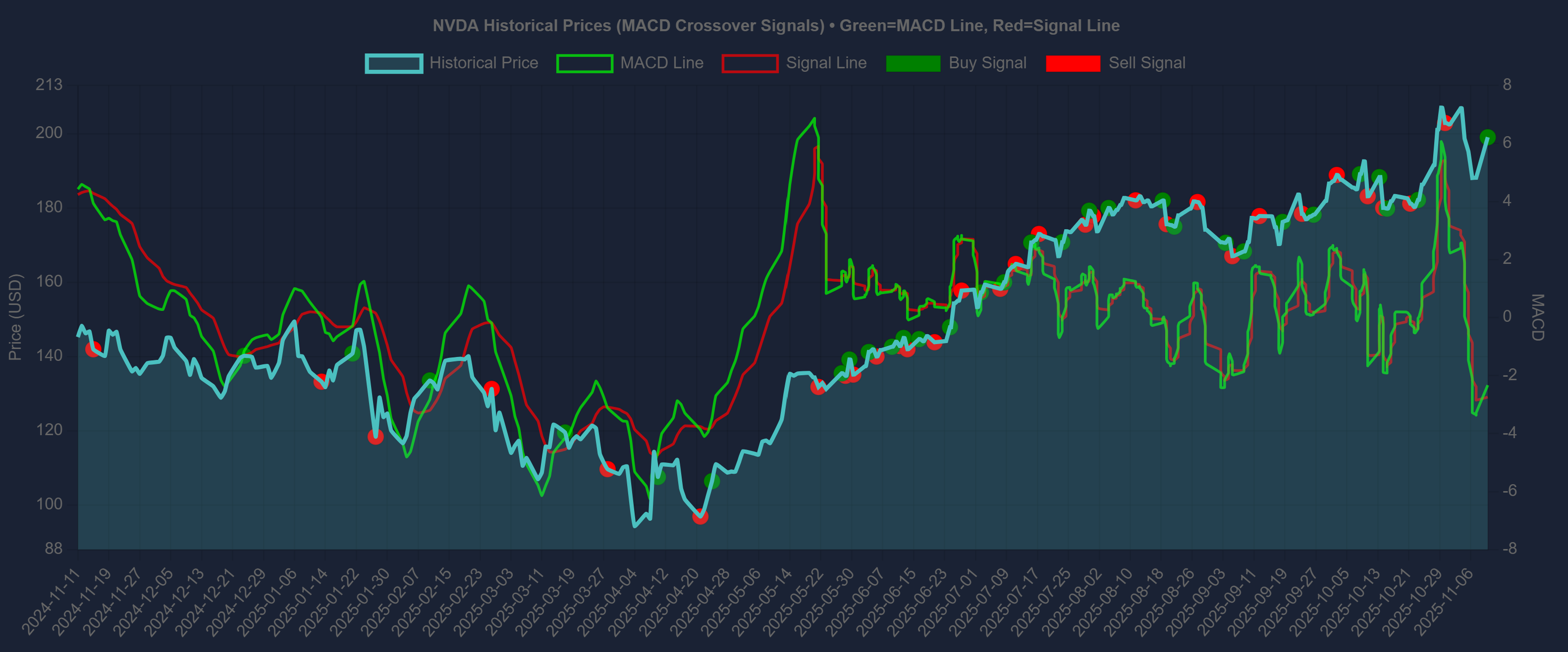
- View the MACD line (green) and Signal line (red) on the chart below the price chart
- Buy and sell signals are marked on the historical price chart
- Click 'Show Signal Charts' to display the MACD panel with both lines
Pro Tip: Look for signals that align with the overall trend. A buy signal during an uptrend is generally more reliable than one during a downtrend.
Best Practices for Using MACD
- Use MACD in conjunction with other indicators (RSI, Moving Averages) for confirmation
- MACD works best in trending markets—it can produce false signals in sideways markets
- Consider the magnitude of the crossover: stronger divergences often indicate more significant moves
- Look for divergences: when price makes new highs but MACD doesn't, it may signal weakening momentum
- MACD signals are most reliable when they align with the overall market trend
MACD vs RSI: Which Indicator Is Better?
MACD and RSI are both momentum indicators, but they measure different things and perform best in different market conditions. Understanding the difference helps you know when to rely on each — or when to combine them for stronger signals.
| Feature | MACD | RSI |
|---|---|---|
| What it measures | Momentum trend direction & strength | Overbought/oversold price levels |
| Best market condition | Trending markets | Range-bound, sideways markets |
| Primary signal type | Crossover and divergence | Level-based (70/30 thresholds) |
| Main weakness | Whipsaws in choppy markets | Stays extreme in strong trends |
| Lead vs lag | More lagging | Slightly more leading |
| Best timeframe | Daily, weekly charts | Daily, 4-hour charts |
The practical answer: use MACD to identify trend direction and momentum shifts, and RSI to time entries within that trend. If MACD shows a bullish crossover and RSI is below 50 (not yet overbought), that is a higher-quality setup than either signal alone. Requiring both indicators to agree meaningfully reduces false positives.
How to Filter Out False MACD Signals
MACD's biggest weakness is generating frequent false signals in sideways, choppy markets. Experienced traders use these filters to cut through the noise:
1. The 200-Day Moving Average Filter
Only take MACD buy signals when the stock is trading above its 200-day moving average, and only take sell signals when it is trading below. The 200 MA cleanly separates long-term uptrends from downtrends. Restricting MACD signals to align with the 200 MA direction significantly reduces the whipsaw rate without requiring any additional indicators.
2. Volume Confirmation
A MACD crossover on above-average volume is far more trustworthy than one on light volume. Institutional money moves markets, and volume is how you see their footprint. If a crossover occurs on below-average volume, wait for confirmation — either the next session's candle closing in the signal direction or a volume spike — before committing capital.
3. RSI Alignment
For buy signals, look for MACD crossovers when RSI is between 40 and 60 — not when RSI is already at 70 or above (overbought). For sell signals, look for crossovers when RSI is between 40 and 60 — not when RSI is already at 30 or below (oversold). Signals that occur when RSI is at an extreme are often traps rather than opportunities.
4. The Zero-Line Rule
MACD crossovers near the zero line carry more weight than those that happen when both lines are deeply positive or negative. A bullish crossover well below zero — where both lines are deeply negative — suggests a stronger shift in momentum than one where the lines were already positive. The MACD line itself crossing the zero line (from negative to positive, or vice versa) serves as a secondary trend confirmation.
Important Limitations
While MACD is a powerful tool, it's important to understand its limitations:
- MACD is a lagging indicator—it follows price action rather than predicting it
- In choppy or sideways markets, MACD can generate false signals
- MACD works best when combined with other technical and fundamental analysis
- Past performance doesn't guarantee future results—always use proper risk management
- MACD signals should be used as part of a comprehensive trading strategy, not in isolation
Backtesting MACD: Does It Actually Work?
The honest answer: MACD works meaningfully better in trending markets than in choppy ones, and backtesting helps you understand those boundaries before risking real capital. Raw crossover strategies applied blindly tend to produce mediocre results — but MACD combined with sensible filters consistently outperforms a naive application.
Testing a standard MACD crossover strategy (12, 26, 9) on SPY over recent years reveals a nuanced picture:
- Strong trending years (2019, 2023, 2024): MACD crossovers frequently caught the bulk of major moves while keeping traders out of brief corrections that felt worse in real time than they looked in hindsight
- Volatile, range-bound periods (2015–2016, mid-2022): whipsaws dominated, with multiple back-to-back signals that went nowhere and eroded returns through transaction costs
- With a 200-day MA filter applied: false signal rate dropped substantially, at the cost of missing the first few percent of some recoveries — a worthwhile tradeoff for most investors
You can run these exact tests on any stock or ETF using BriMindInvest's Strategy Backtester. Compare MACD crossover performance directly against buy-and-hold, DCA, and RSI-based strategies across your chosen time window — on real historical data, not theoretical back-of-envelope math.
Frequently Asked Questions About MACD
Try MACD Signals Now
Start analyzing stocks with MACD signals and see how momentum indicators can help inform your trading decisions.
Frequently Asked Questions
Read Next
Unlock Full AI-Powered Analysis
Get AI prediction signals, unlimited stock comparisons, portfolio analytics, and personalized watchlists — free for 14 days, no credit card required.
14-day free trial · No credit card required · Cancel anytime