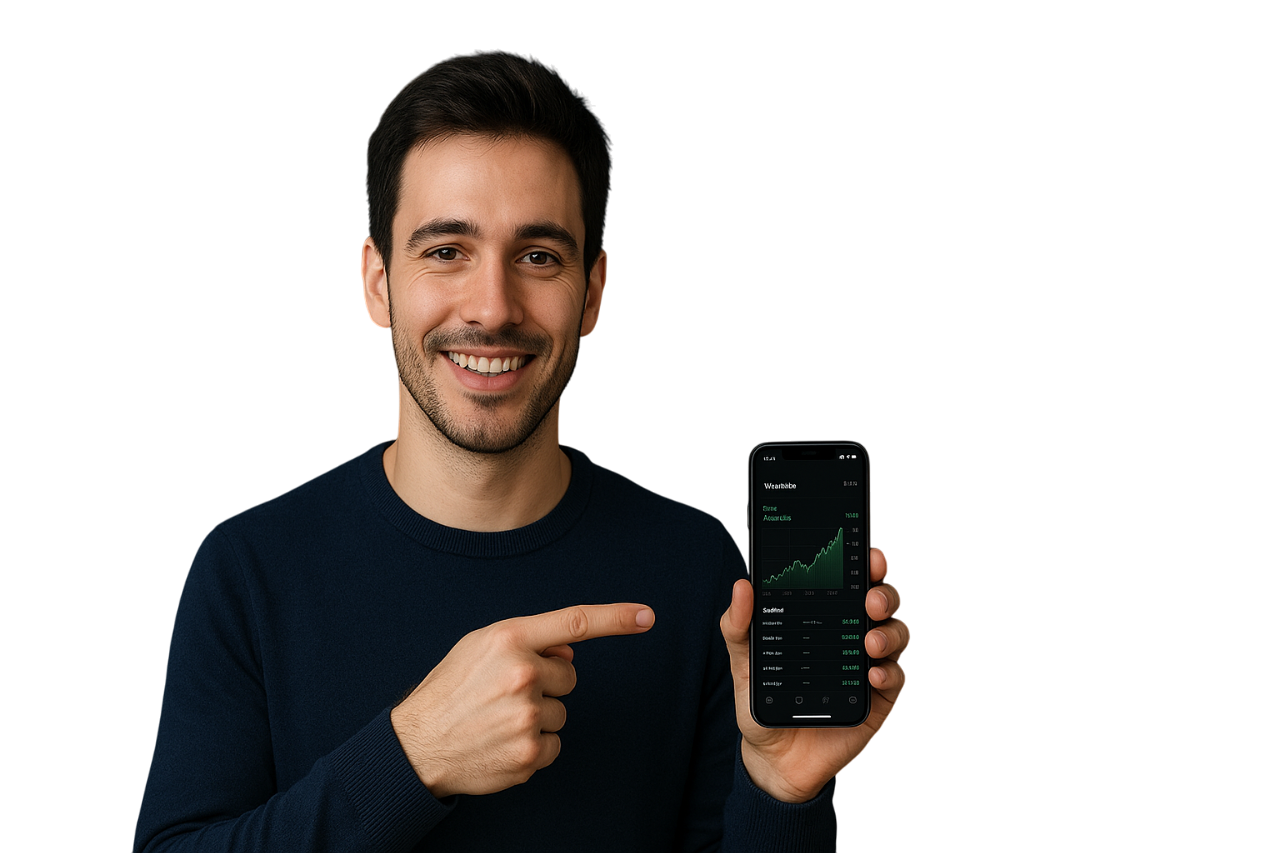
A 5-minute walkthrough to get the most out of your BriMindInvest Watchlist
Why Your Watchlist Matters
Every investor needs a focused view of the market—without the noise. Your watchlist brings together real-time data, AI signals, and curated news to help you monitor stocks and ETFs with clarity.
Add Stocks in Seconds
Simply type a ticker (like AAPL, MSFT, or NVDA) and hit add. The app instantly fetches live data, trend lines, and AI-generated insights—so you can build your personalized list in seconds.
Search by symbol and click Add
Symbols save automatically between sessions
Tap Remove anytime to refine your list
Your Smart Dashboard at a Glance
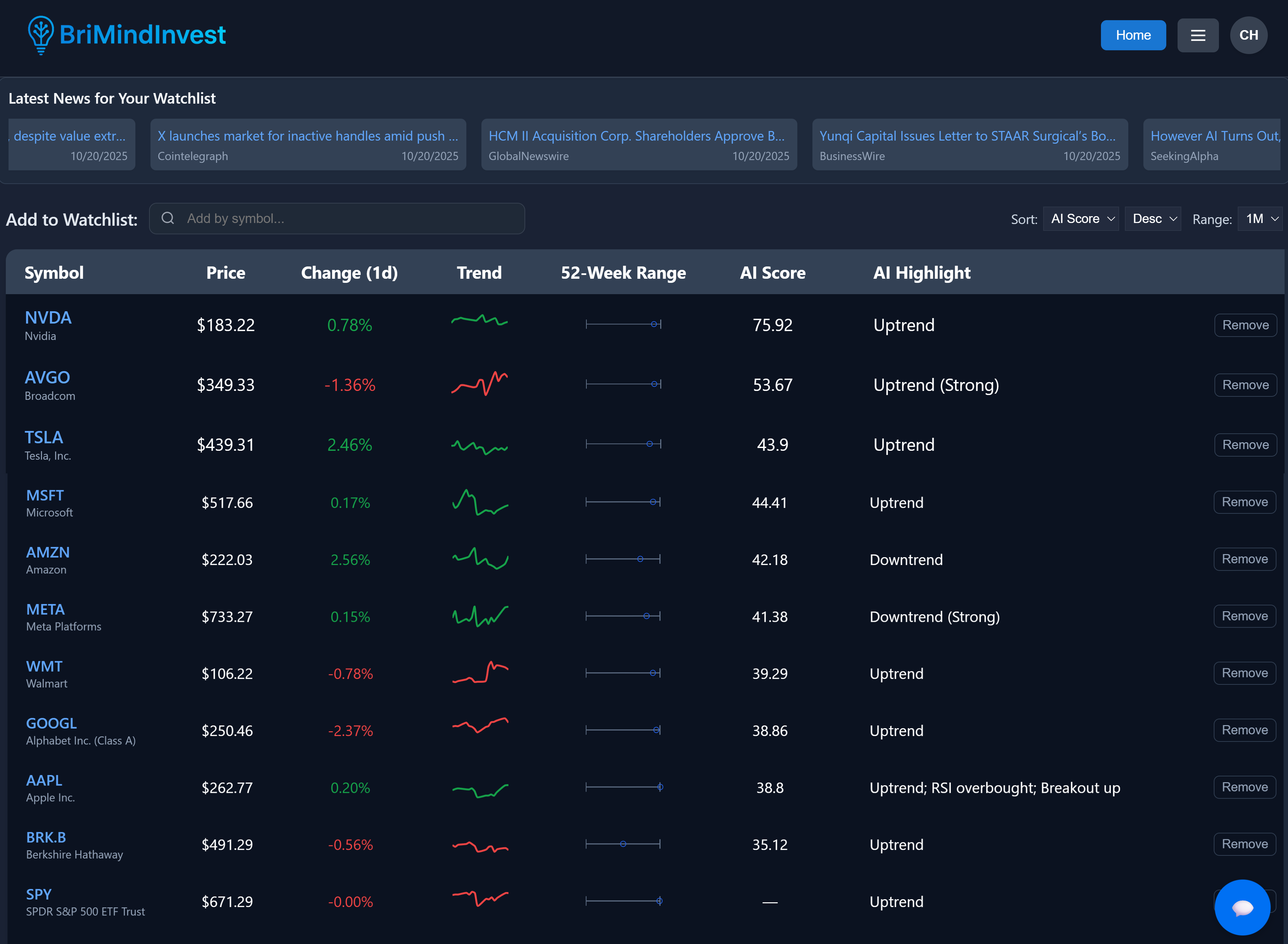
Here’s how your BriMindInvest Watchlist looks in action — blending live data, AI scoring, and real-time trend visualization.
Price & daily change: clear green/red movement indicators
Mini sparkline trend: quick visual cue of direction
52-week range: know where current price stands historically
AI Score: our algorithmic confidence on momentum & risk
AI Highlight: instant summary of uptrend, breakout, or pullback
AI Highlights: Context That Matters
Each symbol is summarized with an AI-driven insight—an at-a-glance read of technical and sentiment signals. You’ll know whether a stock is showing strength, facing headwinds, or breaking trend—all without deep chart analysis.
Pro Tips for Everyday Investors
Combine core ETFs with your top stock picks for balance
Use your mobile device for quick check-ins during the day
Click any stock to see its detailed metrics and 5-day forecast
Ask AI in plain English: 'What’s driving NVDA’s uptrend this week?'
Fast. Efficient. Always Updated.
The watchlist loads cached prices instantly and refreshes in the background. You get near-real-time insights without the wait—perfect for quick daily reviews.
Building Your Watchlist: The 5-Tier System
Most investors keep a flat list of stocks they "like" — which leads to paralysis when it's time to act. A tiered watchlist imposes clarity: every stock has a defined role and a defined action threshold.
Tier 1
5–10 stocks
70–80% of portfolio
Core Holdings
Your highest-conviction positions. You've done deep research, the thesis is intact, and you're comfortable owning through volatility. These don't change often — add only on high conviction and significant research.
Tier 2
15–20 stocks
Monitoring — waiting for entry
Active Watchlist
Companies you understand well and would buy at the right price. Thesis is complete; you're waiting for valuation to improve or a catalyst to confirm. Check these weekly.
Tier 3
30–50 stocks
Early-stage investigation
Research Pipeline
Names on your radar that need more work before reaching Tier 2. You may have read one article, noticed the ticker, or heard it on a podcast. These get researched opportunistically.
Tier 4
Unlimited
Researched and ruled out
Avoid List
Companies you've analyzed and specifically decided against — and crucially, why. This prevents you from re-researching the same stocks repeatedly and forces intellectual honesty about past decisions.
Tier 5
3–5 sources
Feed the top of the funnel
Idea Sources
The podcasts, newsletters, screeners, and communities where new Tier 3 ideas come from. Examples: 13F filings from managers you respect, Finviz momentum screeners, earnings call transcripts for stocks in adjacent sectors.
The system works because it removes the most common watchlist failure mode: a long undifferentiated list that you scroll through but never act on. When a stock is in Tier 2 and hits your target price, the decision to buy is already made. Tier 4 prevents you from re-falling in love with companies you've already rejected.
Free Tools for Your Watchlist
The best watchlist uses multiple tools — each fills a different gap. Here's how to combine them without paying $200/month in subscriptions.
Yahoo FinanceFree
Best for: Quick price checks, basic charts, portfolio tracker
Daily price monitoring; everyone should have it
FinvizFree (Elite ~$39/mo)
Best for: Stock screener, heat maps, insider trading tracker
Finding new ideas; screening by fundamentals or technicals
Seeking AlphaPremium ~$299/yr
Best for: Earnings call transcripts, deep-dive analysis, quant ratings
Investors doing serious research on individual names
Simply Wall St~$10/mo
Best for: Visual financial analysis (snowflake chart), DCF valuation
Visual learners; quick company health scan before deep dive
KoyfinFree tier available
Best for: Institutional-grade charting, macro dashboards, comps tables
Serious investors who want Bloomberg-lite at no cost
Recommended free stack: Yahoo Finance (daily monitoring) + Finviz (screening) + Koyfin (fundamental deep dives). This combination costs $0 and covers 90% of what most individual investors need. Add Seeking Alpha only if you trade around earnings frequently — the transcript access alone is worth it for active investors.
Watchlist Cadence: When to Check What
Checking your watchlist constantly increases anxiety without improving decisions. The most effective investors follow a structured review cadence — checking different things on different schedules.
Daily (5 min)
Earnings releases for Tier 1–2 holdings
Position-specific breaking news
Any stock that moved ±5%+ and why
Pre-market movers in your sectors
Weekly (30 min)
Sector performance vs S&P 500
Macro headlines (Fed, jobs, CPI)
Tier 2 watchlist — any entry triggers hit?
New 52-week highs/lows in your sectors
Monthly (1–2 hrs)
Full portfolio review vs benchmark
Thesis check: is the original thesis still intact?
Update price targets for Tier 1–2 names
Promote 1–2 Tier 3 names to Tier 2 if research complete
Quarterly (half-day)
Rebalance check — any position exceed 20% of portfolio?
New idea generation from Tier 5 sources
Review Tier 4 avoid list — anything changed?
Read 1–2 earnings transcripts for companies you own
The daily check should take under 5 minutes. If it takes longer, you're watching too many positions or reacting to noise rather than signal. The quarterly review is the most important: that's when you ask whether your thesis for each holding is still valid, or whether the world has changed and you need to update.
The 5 Most Common Watchlist Mistakes
After watching thousands of investors build and abandon watchlists, these are the patterns that consistently lead to poor outcomes — and how to avoid them:
The 200-Stock Watchlist
Cap your watchlist at 50–70 total names across all tiers. Anything larger becomes a vanity exercise — you cannot monitor 200 companies meaningfully, so you end up monitoring zero of them. Every name you add should displace one that's less deserving of attention. Scarcity forces better curation.
Watchlisting Without a Price Target
Every Tier 2 name needs a defined entry price or conditions before it goes on the watchlist. 'I like this company' is not a watchlist entry — 'I'd buy AMD at $280 on the thesis that MI400 ramp drives data center revenue above $8B/quarter' is. Without the trigger, the watchlist is just a wish list.
No Thesis Documentation
For each Tier 1–2 holding, write one paragraph explaining why you own it and what would make you sell. Store this anywhere — a notes app, a spreadsheet, a voice memo. Without documentation, you'll convince yourself the thesis is still intact long after it has broken, because your memory of why you bought will fade and be replaced by anchoring to current price.
Falling in Love with Your Watchlist Losers
A falling stock is not automatically a 'better deal.' Move a stock to Tier 4 (Avoid) if the thesis is broken, regardless of how much it has fallen. Investors chronically over-monitor fallen names because of attention bias — the pain of watching losses creates obsessive checking that reinforces the false belief that price recovery is imminent.
Ignoring the Sector Context
Individual stock analysis is incomplete without understanding the sector environment. A great company in a structurally declining sector (print media, traditional retail, legacy telecom) requires a much higher fundamental bar to hold than a good company in an expanding sector. Your watchlist should note each stock's sector and carry a brief thesis on why that sector is worth exposure at all.
The discipline that separates effective watchlists from useless ones is the same discipline that separates good investing from bad: clarity about why you own what you own, and willingness to act when conditions change. A watchlist is not a scorecard for which tickers you like — it is an actionable decision-support system.
A practical implementation rule for busy investors: spend 15 minutes at the start of each month promoting, demoting, or removing exactly three names. Promoting means a Tier 3 name has earned Tier 2 status because the research is complete and a price target is set. Demoting means a Tier 2 name has been waiting for an entry point so long that the original thesis may be stale — send it back to Tier 3 for re-evaluation. Removing means a Tier 4 name no longer needs monitoring because the competitive or regulatory situation has resolved. This monthly three-name discipline keeps the watchlist dynamic and prevents the staleness that causes most watchlists to become irrelevant within six months of creation.
Try It Yourself
Add your first few tickers now and see your watchlist evolve with live data and AI highlights.
A watchlist is only valuable if you act on it. The most common failure mode is maintaining a large Tier 2 watchlist where everything perpetually "needs more research." Set a simple rule: any stock that has been in Tier 2 for more than 6 months without a clear reason gets demoted to Tier 3 or the Avoid list. Watchlists that grow indefinitely without action are worse than useless — they create the illusion of having a strategy without the discipline to execute one.
Common Watchlist Mistakes to Avoid
The watchlist is only as good as the habits around it. These are the most frequent mistakes that cause investors to maintain impressive-looking lists that produce no results:
Watching without researching
Adding a ticker because you heard it on a podcast, then never reading a single earnings report. You end up holding 40 names you half-know. Cap your watchlist at what you can actually monitor and understand.
No price target
Tracking a stock without a defined entry price turns the watchlist into a passive collection. Every Tier 2 name needs a written entry thesis: 'I'd buy AAPL at $170 because that represents a 22x forward P/E on my $7.80 EPS estimate.' Without this, you'll watch opportunities pass and still not act.
Letting losers linger
Keeping stocks that have broken their thesis 'just in case' clutters the list and dilutes attention from real opportunities. The Avoid tier exists for a reason. If the original thesis is no longer valid, move the name out of active tiers and document why.
Checking prices without context
Looking at a stock's daily price movement without reading why it moved is pure noise consumption. If you check prices daily, commit to only acting on price movements accompanied by news or data you've read. Otherwise check weekly.
No position sizing plan
Knowing you want to buy a stock is only half the decision. Having no position size in mind leads to either under-investing (buying a tiny starter position that barely matters) or over-investing (taking a concentrated bet without thinking through the risk). Define your maximum position size before adding a name to Tier 2.
How to Research a New Stock for Your Watchlist: A 5-Step Process
The difference between a stock that sits in Tier 3 forever and one that earns a spot in Tier 2 is completing a structured research process. This 5-step framework takes 1–3 hours for most companies and covers everything needed to make a buy/pass decision:
After completing these five steps, you should be able to answer: "I would buy this company at $X because [valuation thesis], and my bear case is [specific risk] which I think is manageable because [reason]." If you cannot articulate that sentence, the stock belongs in Tier 3 — not Tier 2.
Frequently Asked Questions About Stock Watchlists
How many stocks should I have on my watchlist?+
Most investors manage 15–30 stocks across all tiers effectively. Beyond that, the list becomes unmanageable — research quality degrades as you spread attention thinner. A focused watchlist of 20 companies you know deeply outperforms a scattered list of 100 companies you barely know. If you find yourself adding more than 5 new names per month, you're building a collection, not a watchlist. Quality over quantity is the cardinal rule.
When should I remove a stock from my watchlist?+
Remove a stock when: (1) the original thesis has broken — the competitive advantage eroded, management changed, or the industry structure shifted unfavorably; (2) valuation has moved so far above your target that a reasonable entry is unlikely in the next 12 months; (3) a better opportunity has emerged that deserves your research attention instead. Never remove a stock simply because the price dropped — a fallen price with an intact thesis is a buying opportunity, not a reason to exit your watchlist.
Should I put ETFs on my watchlist alongside individual stocks?+
Yes — many sophisticated investors maintain a hybrid watchlist with broad ETFs (SPY, QQQ, VTI) as market context anchors, sector ETFs (XLK for tech, XLF for financials) as sector monitors, and individual stocks as specific opportunities. The ETFs serve as benchmarks: if NVDA is on your watchlist, having SOXX (semiconductor ETF) nearby tells you whether NVDA's move is stock-specific or sector-wide, which is critical context for making buy/sell decisions.
How do I use the BriMindInvest AI score in my watchlist process?+
The AI score works best as a screening and confirmation tool, not a standalone buy signal. In practice: use it to identify momentum shifts on stocks you already know well (a rising AI score on a company you've researched confirms your thesis is gaining momentum in the data), and to flag when a high-conviction watchlist stock's momentum is deteriorating (a falling AI score during a flat price may signal institutional selling before the price drop is visible).
Not ready to sign up? Get one free email a week instead.
Data sources & disclosures: Financial data and metrics cited in this article are sourced from company SEC filings, earnings releases, and investor relations materials. Market prices and fundamental data are provided by financial market data providers. Market size estimates and industry projections are sourced from industry research and analyst reports. Figures reflect information available at the time of writing and may have changed. AI scores and price targets are proprietary estimates — see our Methodology. This article is for informational and educational purposes only and does not constitute financial advice or a recommendation to buy or sell any security. Investing involves risk, including the possible loss of principal. Please read our full Disclaimer and consult a licensed financial adviser before making investment decisions.
We use cookies to keep you signed in and to understand how people use our site (Google Analytics). You can accept all cookies or limit them to what's strictly necessary. Privacy policy